Not every site has a fixed water line to work with. Remote locations, temporary chemical storage, or a workshop mid-renovation still need reliable eye protection — just without the plumbing to support it.
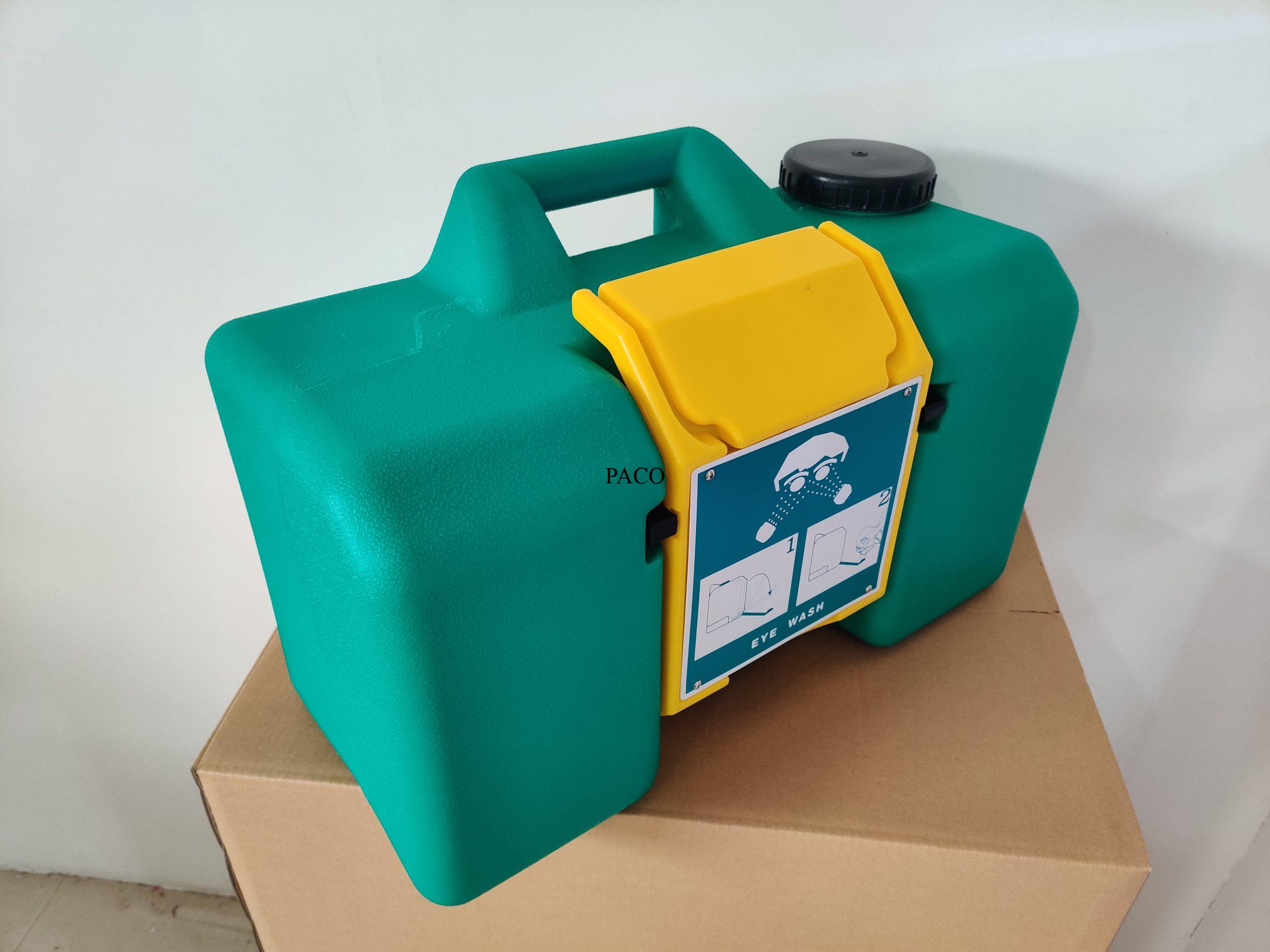
That's the gap Fuka Industries' portable eyewash units are built to close. Each unit holds a 30-litre tank of chemical-resistant water, gravity-fed to deliver a continuous 15-minute flush — no installation, no fixed connection, just a unit you place wherever the hazard is. A push-pull tray keeps the nozzles sealed until they're needed, so dust and airborne contaminants stay out.
Wall-mounting hardware comes with every unit, and with supply reaching Klang, Melaka, Penang, and Johor, getting one to your site — wherever it is — shouldn't be the hard part.
01Why Portable Eyewash Stations Are Essential
The first 10 to 15 seconds after chemical exposure decides the outcome. Portable eyewash stations exist for exactly that window — a first line of defence when there's no plumbed station nearby.
"The first 10 to 15 seconds after chemical exposure decides the outcome."
Flexibility & Mobility
Carry it onto a construction site, into a temporary chemical store, or out to a remote work area — set it down where the hazard actually is.
Rapid Response
A worker splashed while replacing a forklift battery or mixing cleaning agents needs the water going immediately — no fumbling, no delay.
Cost-Effective Compliance
Meets the same flushing need as a plumbed station — no water lines, drainage, or permits, and no construction project.
02Key Features and Types of Portable Eyewash Stations
Portable eyewash stations come in several designs, each suited to different sites and budgets.
| Station Type | Best Used For | Key Advantage |
|---|---|---|
| Gravity-Fed Stations | Semi-permanent sites, warehouses, workshops | Long shelf life, continuous 15-minute flow |
| Pressurized Tanks | Remote outdoor sites, construction, utilities | Highly portable, works in rugged environments |
| Personal Eyewash Bottles | Individual tool belts, immediate first-aid | Immediate use while moving to a primary station |
1. Gravity-Fed Portable Eyewash Stations
Gravity-fed units are the most common type used in industrial settings, and it's the design Fuka Industries builds around. Pulling down the activation tray lets gravity feed water through the spray heads — no pump, no power needed.
ANSI Z358.1 requires a minimum of 0.4 gallons per minute for a full 15 minutes — 6 gallons in total. At roughly 7.9 gallons, Fuka Industries' 30-litre tank clears that minimum with room to spare, so the flush doesn't run dry partway through.
2. Pressurized Portable Eyewash Stations
Pressurized units use a stainless steel or heavy-duty plastic tank filled with flushing fluid and pressurized with compressed air. Pressing the activation handle forces the fluid out through the nozzles.
These units hold up well in rugged outdoor environments — oil fields, construction zones, utility service trucks — and many models include a handheld drench hose for rinsing the face, body, or a coworker.
3. Personal Eyewash Bottles (Secondary Stations)
Personal eyewash bottles are small, handheld containers filled with saline or sterile water, carried directly by workers or mounted in visible wall docks near immediate hazards. Under ANSI standards, they're a secondary device — a way to start rinsing immediately while making your way to a primary 15-minute station, not a replacement for one.
03Malaysian Regulations and the ANSI Z358.1 Standard
If your site handles hazardous chemicals, Malaysia's USECHH Regulations 2000 already expects you to have a way to flush someone's eyes or skin fast — enforced by DOSH, and built on the same idea as the well-known US OSHA rule many manufacturers still reference.
The regulation tells you what's needed. The ANSI Z358.1 standard is what most manufacturers use to figure out how well it needs to work. In practice, that means a proper eyewash station should flush for a full 15 minutes without dropping off, activate in one motion so both hands stay free for holding your eyelids open, keep the water comfortably tepid rather than freezing or scalding, and sit close enough that someone can reach it in about 10 seconds.
Fuka Industries' unit was built around exactly that — matching the flow rate and one-motion activation the standard calls for.
04Keeping Your Eyewash Station Ready
A portable eyewash station only helps if the water inside it is actually safe to use. Because the fluid sits still for weeks at a time, it needs a bit of upkeep to stay free of bacteria or mould.
If you're using plain tap water, plan on changing it weekly unless you're adding a water preservative — those can stretch the safe window out to 90–120 days. Some facilities skip the hassle entirely with pre-packaged, pH-balanced saline cartridges, which last up to two years but cost more upfront.
Fuka Industries' unit makes the routine part easy — a large filling cap means topping up or fully draining the tank doesn't turn into a chore, and the built-in water level indicator lets you check at a glance whether it's time for a refill, without opening the tank to look.
Weekly: check the unit is where it should be, unobstructed, full, and that the tray still pulls down smoothly. Yearly: inspect for cracks or wear, and replace the fluid or cartridge on schedule.
05Choosing the Right Unit for Your Site
Picking the right portable eyewash comes down to a few practical questions about your site.
What are you actually exposed to? Check the Safety Data Sheets for the chemicals on site. If you're dealing with corrosive acids or bases, you want a high-capacity primary station — this is where a gravity-fed unit like Fuka Industries' 30-litre model earns its place. If the risk is more nuisance dust or wood shavings, a personal eyewash bottle alongside a centralized station is often enough.
How does Malaysia's heat factor in? Water sitting in a tank through a full day of sun can warm up more than you'd expect, and overly warm water isn't much better than none at all for a proper flush. Keeping the unit out of direct sun and staying on top of your water-change schedule goes a long way toward keeping the fluid usable when you actually need it.
How much does the hazard move around? If your team shifts location often — a mobile service crew, a site under active construction — a lightweight, easily carried unit matters more than raw capacity. If the hazard stays put, like a fixed point in a warehouse, a wall-mounted setup is simply always there when someone needs it.
06What to Do in the Moment
Clear, practiced steps matter most when it counts. Make sure everyone on site knows this sequence:
- 1Move fast. Call for help and get to the nearest eyewash station right away. Don't rub your eyes — it can push chemicals deeper or embed debris.
- 2Get it running. Activate the unit and don't stop to think — every second counts.
- 3Hold your eyelids open. Use your thumbs and fingers to keep both upper and lower lids apart so the water can actually reach behind them, where chemicals tend to pool.
- 4Roll your eyes around. Up, down, side to side — keep them moving in the stream so the whole surface gets flushed.
- 5Don't stop early. Keep going for the full 15 minutes, even if it starts to feel better sooner. The neutralizing takes time.
- 6Get checked out. Once the flush is done, get medical attention — and bring the chemical's Safety Data Sheet with you so the doctors know exactly what they're treating.
Not sure which unit fits your site?
Tell us what you're handling and where — we'll match you to a gravity-fed, pressurized, or personal setup.
Call / WhatsApp 016-323 7860